3. Architecture & Tiers
3.1 The three tiers
The federation is a layered, distributed system:
-
Application tier - end-user applications. They send AQL and consume the combined result set, interpret and present results, and initiate follow-up reads/writes (§12).
-
Federation Tier - the technically transparent intermediary. It (a) accepts a conformant openEHR Query API request, (b) resolves the patient identifier to
{node, ehr_id}outside AQL, (c) dispatches standard AQL keyed onehr_id, (d) combines and annotates results, and (e) routes follow-up reads/writes to the owning node. It maintains the registry (organizations, endpoints, andsystem_id/creating_system_id→ CDR base URLs) that makes routing possible (§6/N21). -
Node tier - a member openEHR CDR and its Query (AQL) API. A node runs ordinary openEHR queries scoped to a single
EHR, and does not need to know it is part of a federation.
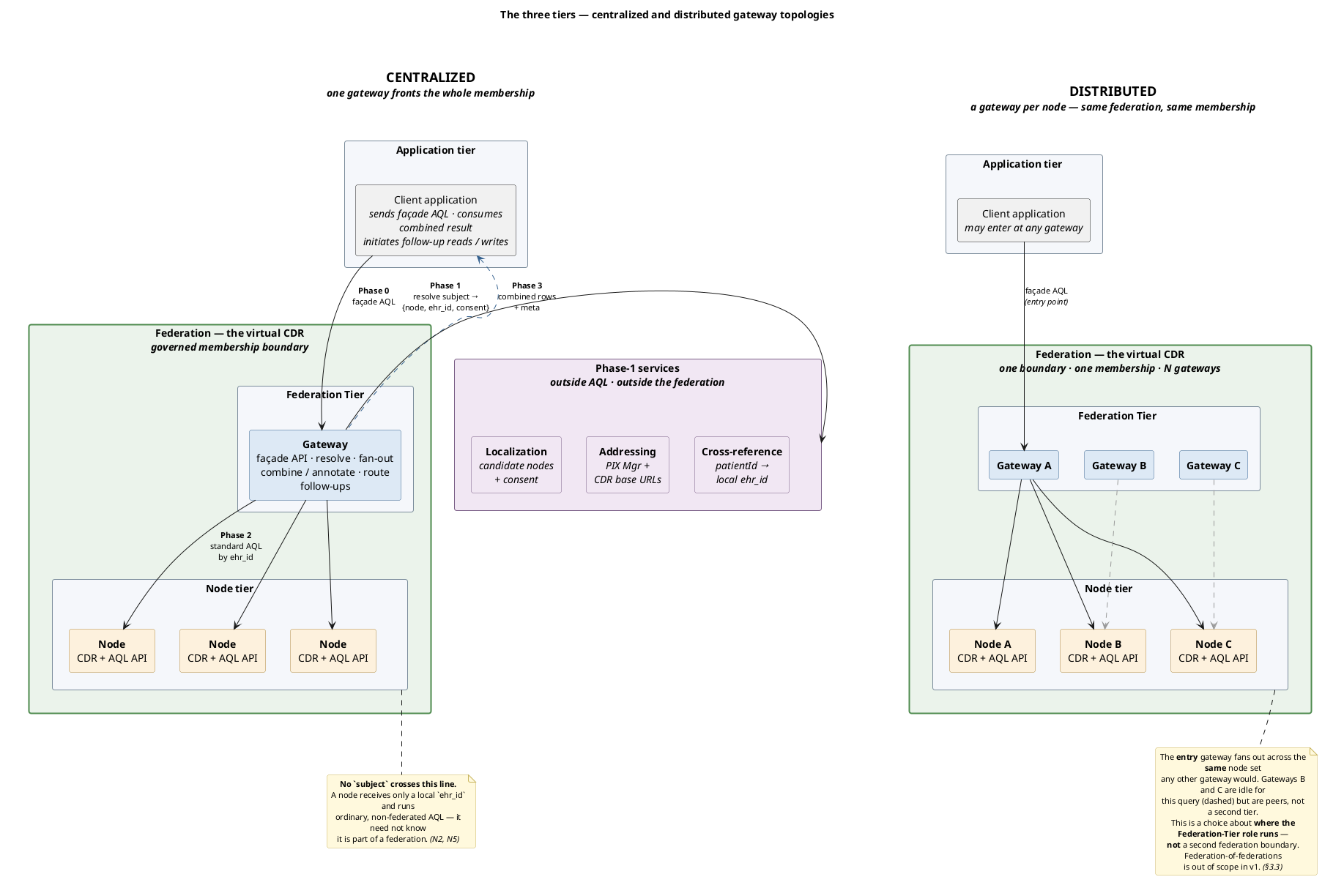
diagrams/federation_three_tiers.puml.3.2 Transparent-intermediary principle
The gateway follows the transparent-intermediary model of the Intermediaries White Paper: the intermediary performs the search across the servers and collates the response, so the client need not know about the multiple contributing sources. Two consequences are normative here:
-
The client interface MUST be a conformant openEHR Query API, and a conformant ITS-REST surface generally (§6/N1, §7a). The client neither sends nor needs any federation-specific syntax to run a basic patient query or a follow-up.
-
Transparency is conditional on completeness. When a node is dropped (unresponsive, timed out, answered with an error, not-resolved, consent-denied) or was never asked (not-localized), the gateway MUST make that visible in metadata (§11.1). Where a node it asked did not answer, the default strategy is to fail the query (§11.4), so that a partial answer is never presented as a whole one and the consumer is not silently misled. An explicit
meta.federation.completeflag accompanies every response, including a failing one. A best-effort mode returning flagged partial rows is available, but only to a client that asks for it. -
Transparency is bounded. Where the gateway cannot behave as a single repository (federated demographics, cross-node object creation,
OFFSETpaging, undirected aggregates) it MUST say so viaOPTIONS(§7a.2) or refuse the request instead of returning an approximation the client cannot detect, because a wrong answer fails transparency worse than an honest refusal does.