4. Reference flow: subject → ehr_id → standard AQL
This section walks the end-to-end flow that the SPECIFICATION (§6) formalises, in terms of the abstract roles a conforming deployment must fill and the proposed IHE binding for each. Two variants are shown: with a localization service and without one. A concrete regional realisation, including a walkthrough on a pseudonymised identifier with no directly identifying identifier in the CDR, is in Annex B (informative), kept out of the normative body on purpose.
4.1 Steps
-
Step 0 - Façade API. The gateway exposes a conformant openEHR Query API (
POST {base}/v1/query/aql, where{base}is the deployment’s ITS-REST base URL - no prefix is mandated, N28). The client MAY identify the patient withWHERE e/ehr_status/subject/external_ref/id/value = <patientId>and MUST NOT need any federation-specific syntax. -
Step 1 - Patient resolution (outside AQL). The gateway extracts
<patientId>(and its issuing namespace) and resolves it to a set of{node, local ehr_id}using three abstract services (proposed IHE binding named; regional realisations in Annex B):-
Localization (undirected queries) - a localization / record-locator service returns candidate source communities. Proposed binding: IHE XCPD. (A localization query MAY, for example, be a national record-locator lookup; in some regions the localizer is consent-aware and its list is already consent-filtered - §14.3, Annex B.)
-
Addressing - an addressing / directory service resolves each community to its local PIX Manager and CDR base URLs. Proposed binding: IHE mCSD.
-
Cross-reference - an identifier cross-reference service maps
<patientId>to the localehr_id(or not-found) per node. Proposed binding: IHE PIXm$ihe-pixwithsourceIdentifier=<patientId>andtargetSystem=<the domain’s ehr_id system>.
-
-
Step 2 - Fan-out. For each node with a resolved
ehr_id, the gateway dispatches standard, non-federated AQL scoped to thatehr_id. -
Step 3 - Combine + annotate. The gateway concatenates rows, applies federation
DISTINCT/ORDER BY, re-injects the requested subject value into rows if the façade AQL SELECTed it (the value is the input, not read from a CDR), adds endpoint-provenance columns if requested, and emitsmeta.federation.endpoints[](including anynot-resolved/consent-denied/not-localized/ unresponsive nodes, each with a status from §11.1).
4.2 Variant A - with a localization service
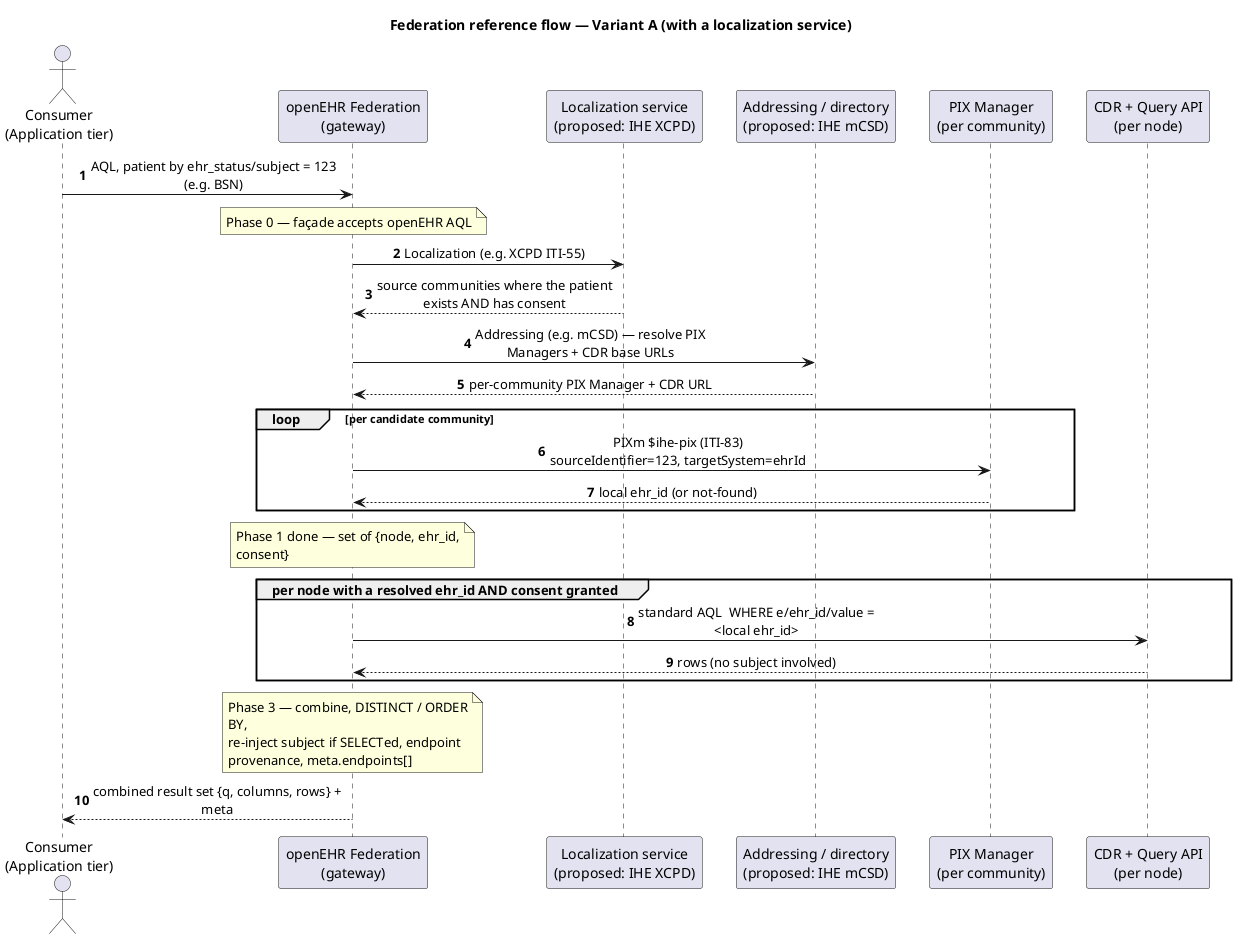
diagrams/federation_flow_with_localization.puml.4.3 Variant B - without a localization service
With no localization service, the gateway skips localization and addressing and asks all known nodes' PIX Managers directly (an ask-all localization fallback; §14/N4). Every node that returns a local ehr_id is queried. The rest are reported in meta.federation.endpoints[] as not-resolved.
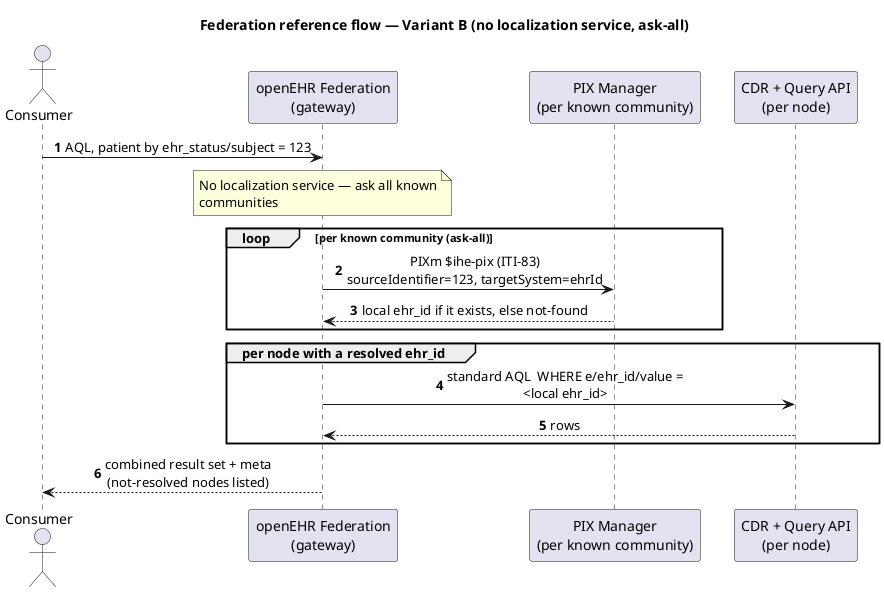
diagrams/federation_flow_without_localization.puml.4.4 The demographic input MAY be pseudonymised
Nothing in this flow requires <patientId> to be a directly identifying identifier (§5.1). Because Step 1 resolves whatever identifier the client presents to a per-node ehr_id outside AQL, the presented identifier MAY be a pseudonymised id, and nodes need store no directly identifying identifier in the CDR. Requirement N5 rests on that principle. A worked example on a pseudonymised identifier is in Annex B §B.7.